
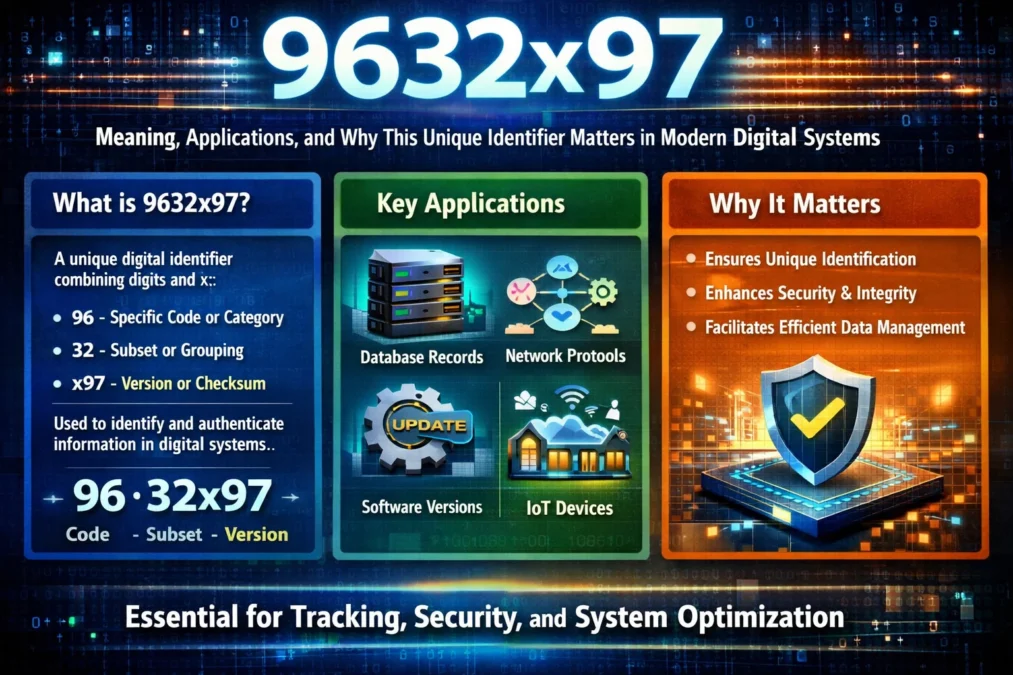

In the modern digital ecosystem, identifiers and coded sequences often carry deeper meaning than they appear to at first glance. One such example is 9632×97, a pattern that has sparked curiosity across technical communities, data systems, and online platforms. Whether encountered in indexing systems, database identifiers, or algorithmic references, 9632×97 illustrates how structured codes can serve as compact containers for complex information.
Understanding 9632×97 requires looking beyond the surface of the numbers and examining how structured identifiers function in digital environments. From database architecture to algorithmic tagging and automated indexing, codes like 9632×97 help systems organize massive volumes of information efficiently while remaining readable to developers and analysts.
Understanding 9632×97
At its core, 9632×97 represents a structured numeric–alphanumeric format that resembles identifiers used in many digital infrastructures. These identifiers often combine numerical sequences with delimiter-style characters to create compact references that can be processed quickly by machines while remaining interpretable by humans.
In many contexts, 9632×97 may function as a reference key, internal system marker, or encoded label within a larger database or platform architecture. The compact format allows it to act as a unique tag, ensuring that a specific record, dataset, or process can be identified without ambiguity.
Origins and Context Behind the Format
The structure of identifiers like 9632×97 reflects long-standing conventions in data organization and indexing. Numeric segments frequently represent hierarchical or categorical information, while separator characters—such as “x”—act as structural markers within the identifier itself.
Developers often design patterns similar to 9632×97 to maintain clarity while supporting large-scale indexing systems. By splitting numerical segments with symbolic separators, systems can group, sort, and retrieve information more efficiently across distributed databases.
Why 9632×97 Matters in Digital Systems
In large-scale data environments, identifiers such as 9632×97 help maintain consistency across applications, APIs, and storage layers. When millions of entries exist in a database, compact reference codes prevent conflicts and ensure precise retrieval of records.
Additionally, structured identifiers like 9632×97 can support automation workflows. Systems can parse each component of the identifier to determine category, sequence order, or processing rules without needing additional metadata.
Common Use Cases for Structured Identifiers
One of the most common environments where patterns like 9632×97 appear is database indexing. Large data systems rely on unique identifiers to link tables, manage relationships, and maintain integrity during high-volume operations.
Another frequent use case is digital asset tracking, where identifiers similar to 9632×97 help categorize documents, software builds, or product components. In these cases, the code acts as both a label and a navigational reference within a broader information architecture.
Structural Breakdown of the Identifier
While 9632×97 may appear simple, its structure can reveal useful information depending on the system where it is used. Each component may correspond to a functional role within the identifier.
| Component | Possible Meaning | Example Function |
|---|---|---|
| 9632 | Primary numeric sequence | Category or dataset ID |
| x | Structural separator | Divides hierarchical segments |
| 97 | Secondary identifier | Version, index, or record number |
In practice, identifiers like 9632×97 often function as compact indexing keys. Instead of storing long descriptive labels in system operations, databases rely on short codes that can be processed quickly and consistently.
Interpreting 9632×97 in Data and Technology Contexts
In data engineering environments, codes like 9632×97 often signal relationships between records or versions. Developers might interpret the first numeric segment as a category identifier while the second segment marks a specific instance within that category.
Another interpretation is that 9632×97 represents a versioned structure, where the prefix indicates a base dataset and the suffix indicates a revision or sub-entry. This approach allows systems to scale without dramatically expanding the length of identifiers.
Misconceptions About Numeric Code Identifiers
One common misconception is that codes such as 9632×97 are random or meaningless. In reality, most identifier systems follow deliberate structural logic designed to support indexing, scalability, and efficient database queries.
Technology strategist Elena Vargas once summarized the value of structured identifiers clearly:
“Short, structured identifiers often carry more operational value than long descriptions because systems can parse them instantly.”
Understanding this principle helps clarify why formats like 9632×97 appear across many technical platforms and indexing systems.
Strategic Value of Compact Identifiers
Identifiers such as 9632×97 provide a powerful balance between simplicity and scalability. When systems rely on consistent formatting, engineers can design automated workflows that categorize, retrieve, and process records without complex parsing logic.
This design philosophy becomes especially important in cloud infrastructure and distributed computing environments. A concise identifier system ensures that records remain traceable even when data moves across services, microservices, and external integrations.
Future Outlook for Structured Identifier Systems
As data volumes continue to grow, the importance of efficient identifier systems will only increase. Formats similar to 9632×97 demonstrate how compact codes can scale across modern architectures without sacrificing readability.
Emerging technologies such as distributed databases, edge computing, and AI-driven analytics rely heavily on consistent indexing methods. In many cases, structured identifiers remain the invisible backbone that allows these systems to function reliably.
Read More: Henry Ruggs Car: The Corvette, the Crash, and the Lessons That Changed the Conversation
Conclusion
Identifiers may appear small within the broader digital landscape, but their role in system organization is enormous. Codes such as 9632×97 demonstrate how carefully designed sequences can simplify data management, indexing, and automation across complex infrastructures.
By understanding how structured identifiers function, developers, analysts, and digital strategists can design systems that remain scalable, efficient, and easy to maintain. Whether used in databases, asset management platforms, or software architectures, patterns like 9632×97 represent the hidden language that keeps modern digital systems organized.
FAQ
What is 9632×97?
9632×97 is a structured identifier format often interpreted as a compact reference code used in indexing, database systems, or digital asset management.
Where might 9632×97 appear?
You might encounter 9632×97 in technical systems such as database records, internal indexing structures, software version tracking, or automated data pipelines.
Is 9632×97 a random code?
In most technical contexts, identifiers like 9632×97 follow structured logic. The segments often represent categories, sequence numbers, or hierarchical identifiers.
Why do systems use identifiers like 9632×97?
Identifiers such as 9632×97 allow systems to store, retrieve, and process data efficiently while keeping reference codes short and machine-readable.
Can 9632×97 represent different things in different systems?
Yes. The meaning of 9632×97 depends on the platform or database where it is used, but its structure typically reflects standard identifier design principles.