
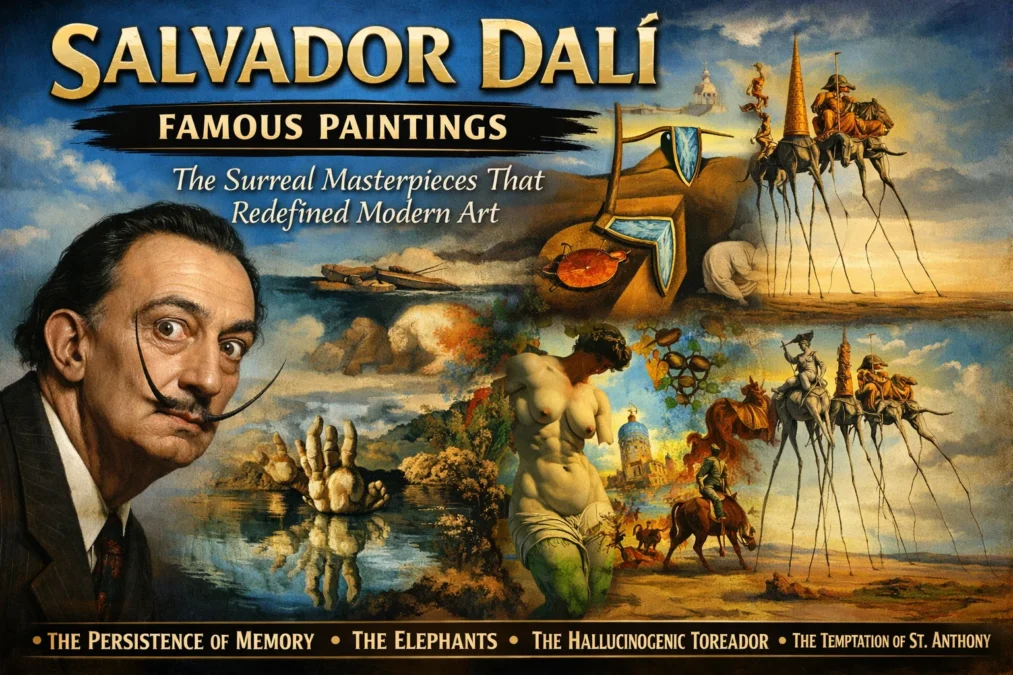

Few artists in history have captured imagination the way Salvador Dalí did. His dreamlike visuals, strange symbolism, and technical brilliance transformed modern art and made his work instantly recognizable around the world. When people search for salvador dali famous paintings, they are often drawn to the bizarre melting clocks, surreal landscapes, and psychological imagery that define his style.
Dalí’s paintings are more than just unusual images. They are explorations of dreams, subconscious fears, philosophy, and reality itself. Through the surrealist movement, Dalí created artworks that blur the line between fantasy and truth, making viewers question what they see. Understanding salvador dali famous paintings offers insight into both the mind of a genius and the evolution of twentieth-century art.
The Artistic Vision Behind Salvador Dalí’s Paintings
Salvador Dalí was a central figure in the Surrealist movement, a cultural and artistic revolution that explored the unconscious mind. Inspired by psychoanalysis and dream interpretation, Dalí developed a method he called the “paranoiac-critical method,” allowing him to tap into irrational imagery and transform it into meticulously painted scenes. This approach gave birth to many of the salvador dali famous paintings admired today.
Despite their strange subject matter, Dalí’s technique was deeply classical. He studied Renaissance masters and used traditional painting methods to create highly detailed compositions. The result was a fascinating contrast: dreamlike concepts presented with photographic realism. This combination made his art both intellectually stimulating and visually unforgettable.
The Persistence of Memory and the Iconic Melting Clocks
Among all salvador dali famous paintings, The Persistence of Memory is arguably the most recognized. Painted in 1931, the artwork features melting pocket watches draped across a barren landscape, symbolizing the fluid and subjective nature of time. The soft clocks appear to dissolve, suggesting that time in dreams behaves differently from time in reality.
The painting’s mysterious central figure, often interpreted as a distorted self-portrait of Dalí, reinforces the dreamlike atmosphere. The quiet desert landscape and eerie stillness create a powerful sense of surreal contemplation. This masterpiece remains one of the most reproduced and analyzed works in modern art history.
The Elephants and Dalí’s Symbolism
Another entry among salvador dali famous paintings is The Elephants, created in 1948. The artwork depicts massive elephants with impossibly long, thin legs carrying heavy obelisks on their backs. The contrast between strength and fragility creates tension and intrigue, a hallmark of Dalí’s surreal symbolism.
These elongated animals often appear in Dalí’s work and are thought to represent power, desire, and spiritual burden. Their towering presence against a barren landscape gives the painting a sense of surreal grandeur. Like many Dalí works, it invites multiple interpretations, encouraging viewers to project their own meanings onto the imagery.
Dream Caused by the Flight of a Bee Around a Pomegranate
One of the most imaginative examples of salvador dali famous paintings is Dream Caused by the Flight of a Bee Around a Pomegranate a Second Before Awakening. Created in 1944, the painting visualizes the moment when a dreamer’s mind reacts to an external stimulus while asleep.
The composition shows a floating nude figure surrounded by surreal imagery, including a pomegranate, tigers leaping from a fish, and a rifle about to strike. Dalí uses this dramatic scene to illustrate how the subconscious rapidly constructs elaborate dream narratives from simple sensory triggers. The result is both theatrical and psychologically fascinating.
The Sacrament of the Last Supper
Dalí’s later career moved toward spiritual themes, and The Sacrament of the Last Supper stands among the most profound salvador dali famous paintings from this period. Completed in 1955, the artwork presents a surreal interpretation of the biblical scene, placing Christ and the apostles inside a transparent geometric structure.
The painting merges classical religious iconography with Dalí’s fascination with mathematics and cosmic order. Soft lighting, precise composition, and mystical symbolism create a sense of divine transcendence. This work demonstrates how Dalí evolved beyond pure surrealism to explore spirituality and metaphysical concepts.
Soft Construction with Boiled Beans (Premonition of Civil War)
Painted in 1936, Soft Construction with Boiled Beans is one of the most disturbing yet powerful salvador dali famous paintings. The artwork portrays a grotesque, fragmented figure tearing itself apart, symbolizing the violence and chaos of the Spanish Civil War.
Dalí completed the painting months before the conflict officially began, which led many critics to view it as prophetic. The surreal creature represents a nation destroying itself, emphasizing the horror of political division. The beans scattered around the scene add an element of dark irony, reflecting Dalí’s fascination with absurdity.
Major Salvador Dalí Paintings Overview
Below is a structured look at some of the most influential salvador dali famous paintings, including their themes and artistic significance.
| Painting | Year | Core Theme | Why It Matters |
|---|---|---|---|
| The Persistence of Memory | 1931 | Fluid perception of time | One of the most recognizable surrealist artworks |
| Dream Caused by the Flight of a Bee | 1944 | Dream psychology | Illustrates subconscious storytelling |
| The Elephants | 1948 | Power and fragility | Iconic surreal symbolism |
| Soft Construction with Boiled Beans | 1936 | War and destruction | Political and psychological commentary |
| The Sacrament of the Last Supper | 1955 | Spiritual surrealism | Blends religion, mathematics, and art |
These works collectively demonstrate the diversity and depth found within salvador dali famous paintings.
Dalí’s Unique Surrealist Style
The defining characteristic of salvador dali famous paintings is their striking visual paradox. Dalí combined hyper-realistic painting techniques with bizarre, dreamlike imagery. The result feels simultaneously believable and impossible, drawing viewers into a surreal mental landscape.
His paintings frequently include recurring symbols such as ants, eggs, crutches, elephants, and melting clocks. These elements act as visual metaphors related to decay, birth, weakness, and transformation. By repeating these motifs across different works, Dalí created a complex symbolic language that continues to fascinate art historians.
Cultural Impact of Salvador Dalí’s Paintings
The influence of salvador dali famous paintings extends far beyond traditional art galleries. Dalí’s surreal imagery has shaped film, fashion, photography, and digital media for decades. Directors, designers, and illustrators frequently draw inspiration from his imaginative compositions.
Modern pop culture references Dalí’s visual style regularly. Melting clocks, dreamlike landscapes, and surreal distortions appear in advertising campaigns, music videos, and digital artwork. This cultural reach demonstrates how Dalí’s artistic vision continues to inspire new generations of creatives.
Quote Reflecting Dalí’s Artistic Philosophy
Salvador Dalí once summarized his approach to creativity with a statement that perfectly captures the spirit of his work:
“Have no fear of perfection—you’ll never reach it.”
This perspective explains why salvador dali famous paintings often feel experimental, daring, and unconstrained. Dalí believed artistic innovation came from pushing beyond conventional rules and embracing imagination without limits.
Conclusion
The enduring fascination with salvador dali famous paintings lies in their ability to challenge perception and ignite curiosity. Dalí transformed personal dreams and psychological ideas into visually stunning artworks that still feel modern decades later.
From the melting clocks of The Persistence of Memory to the spiritual symbolism of The Sacrament of the Last Supper, Dalí’s masterpieces represent a unique intersection of technical skill and boundless imagination. His legacy reminds us that art is not only about representation but also about exploring the mysteries of the human mind.
Anyone exploring surrealism, modern art history, or creative inspiration will inevitably encounter the extraordinary world of salvador dali famous paintings.
Read More: United Flight UA967 Diverted: What Happened, Why It Matters, and What Travelers Should Know
FAQ
What are the most famous Salvador Dalí paintings?
Some of the most recognized salvador dali famous paintings include The Persistence of Memory, Dream Caused by the Flight of a Bee Around a Pomegranate, The Elephants, Soft Construction with Boiled Beans, and The Sacrament of the Last Supper.
Why are Salvador Dalí’s paintings considered surreal?
The surreal nature of salvador dali famous paintings comes from their dreamlike imagery, unexpected symbolism, and exploration of subconscious ideas inspired by psychoanalysis.
Where can you see Salvador Dalí’s paintings today?
Many salvador dali famous paintings are displayed in major museums, including the Museum of Modern Art in New York and the Dalí Theatre-Museum in Spain.
What themes appear in Salvador Dalí’s artwork?
Common themes in salvador dali famous paintings include time, dreams, psychological conflict, religion, decay, and transformation.
Why is The Persistence of Memory so famous?
This painting is among the most iconic salvador dali famous paintings because its melting clocks became a universal symbol for the surreal and flexible nature of time.